ImagineOS
A sovereign, Rust-native AI operating system. One unified binary orchestrating multi-agent reasoning, persistent memory, and workflow execution — locally, without cloud dependency.
Migration Impact
From legacy Node.js/Next.js to a single Rust-native binary
Platform Components
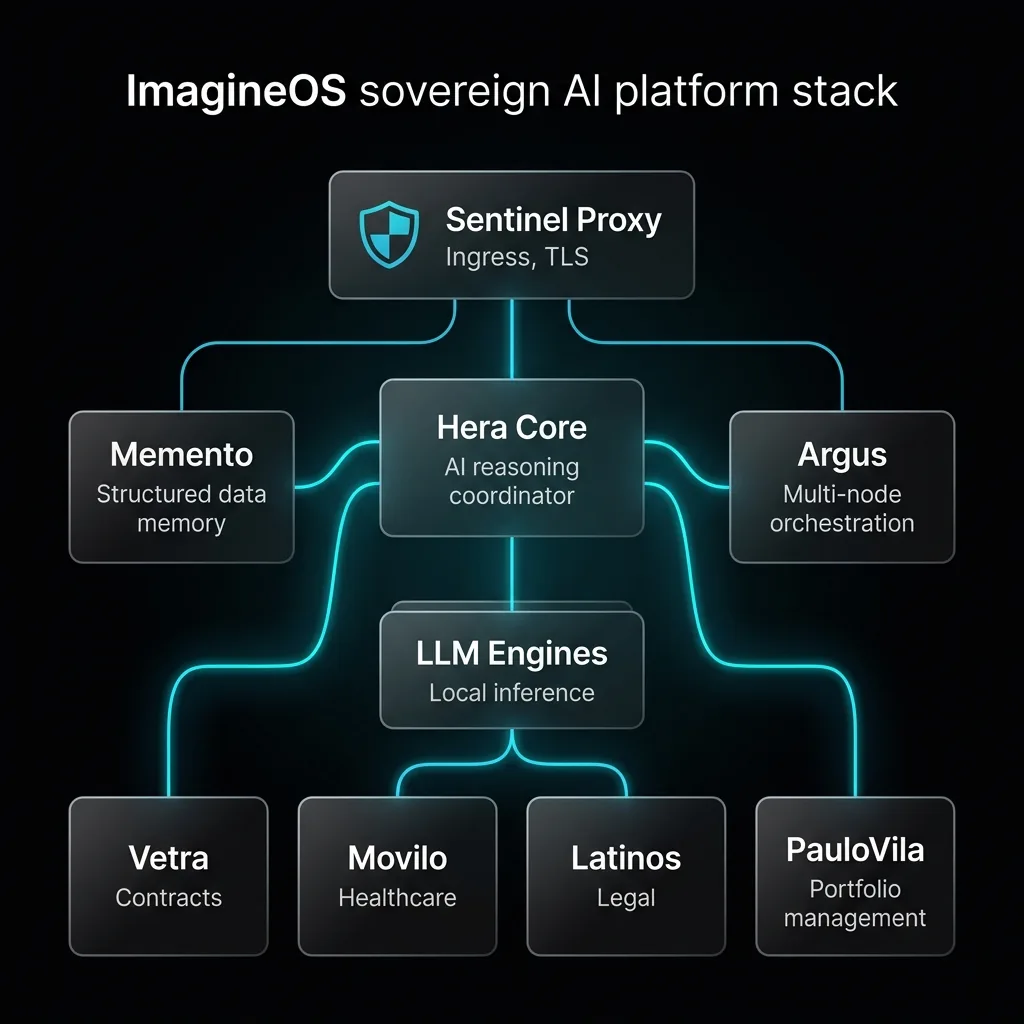
Sentinel Rust / Caddy
Reverse proxy and gateway. Handles TLS termination, routing, rate limiting, and abuse filtering across all platform apps.
Hera Core Rust / Tokio
AI reasoning coordinator. Routes IPC requests to local LLM engines (llama.cpp, sd.cpp) with cloud failover. Tool execution, multi-agent spawning, and inference-time compute.
Memento Rust / PostgreSQL
Structured data layer and persistent memory. Every app queries through Memento IPC sockets — zero direct SQL from application code.
Argus Rust
Multi-node orchestration and server-farm routing. Manages compute distribution across physical nodes as the infrastructure scales.
Imaginclaw Vanilla JS
Universal AI chat widget. Embeddable in any app via a single script tag. Connects to Hera for multi-agent reasoning with streaming responses.
OS-v3 Runtime Loco.rs
Shared application framework: auth flows, shared templates, tool definitions, skill playbooks, and agent personas. Apps inherit platform capabilities.
Architecture Principles
Local-First
All processing happens natively. Cloud APIs are strictly failover. No dependency on external services for core functionality.
Pure Rust
Single-language stack: Loco.rs for web, Tokio for async, FFI for C++ engines. No garbage collector, no runtime overhead.
Shared Memory IPC
No REST/HTTP between internal services. Unix Domain Sockets and direct memory addressing for tensor/vectorial data.
Zero-State VRAM
Test models in vacuum. Multi-tier quantization (Q2–Q8) for different hardware profiles from laptops to server farms.
Tool-Agent-Skill Hierarchy
Tools are atomic scripts. Agents are parallel workers. Skills are domain playbooks. All orchestrated by Hera.
Resilience Layer
Every capability has a backup. Local engine → Cloud failover. No single point of failure in the reasoning chain.
Interested in the Architecture?
Ask Paulo's AI for a deep-dive on any component, or download the executive CV for consulting inquiries.
Ask Paulo's AI →